 for animal tracking data
# August 2026 Newsletter
Dear Movebank users,
We are writing with a mid-year update to celebrate some major milestones and new opportunities. Read on for stories behind the growth of Movebank and to join the global effort to contribute Movebank data to MoveTraits, the new open-access behavioral trait database.
Movebank exceeds 10 billion locations
In March 2026, the Movebank database grew to include more than 10 billion animal occurrences! We were monitoring the monthly statistics, and the study that pushed us over the edge was a project on Egyptian fruit bats (Rousettus aegyptiacus) led by Prof. Ran Nathan and his colleagues in the Movement Ecology Lab at the Hebrew University of Jerusalem, Israel.
This species is known for its remarkable navigation ability, enabling it to return directly to its roost after being translocated up to 84 km to an unfamiliar location. This research uses this tracking effort to better understand cognitive map-based navigation, spatial memory, and the role of social cues in this highly gregarious species. Prof. Nathan and his team track the bats using ATLAS, a high-throughput regional-scale reverse-GPS tracking system that produces high-resolution movement data at GPS accuracy from bats as small as 7 g and birds as small as 15 g, automatically and simultaneously, with data becoming available to the user in near-real time, typically within a minute.
The threshold of 10 billion locations was passed with the addition of the Movebank study ATLAS Hula Rousettus aegyptiacus Phil. Trans. R. Soc. B, which holds the tracking data behind a field experiment showing how bats combine spatial memory and social cues to locate food without following one another (Lourie et al. 2024, Phil. Trans. R. Soc. B). More than 8 million ATLAS locations from this study were uploaded in March. The same long-term tracking effort has also fed into earlier work, including the first ATLAS-based paper, which revealed cognitive map-based navigation in wild bats (Toledo, Shohami et al. 2020, Science).
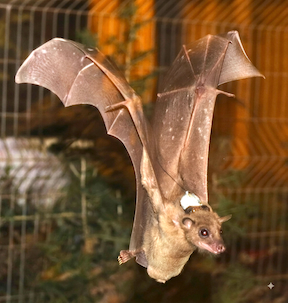
Egyptian fruit bat (Rousettus aegyptiacus) fitted with an ATLAS tag
(photo by Emmanuel Lourie)
Movebank welcomes its 10,000th study
The Movebank database is growing in more ways than one. In spring of this year, Movebank surpassed 10,000 user-created studies! We are excited to highlight the study Satellite tracking Magellanic penguins 2026, which was created around the time we reached this milestone. Dr. Pablo Borboroglu (founder and President of the Global Penguin Society) and Dr. Thomas Mattern (Global Penguin Society Oceania Representative) have been satellite-tracking Magellanic penguins (Spheniscus magellanicus) since 2023 to better understand the migration, habitat use, and conservation needs of this species. The waterproof tracking devices equipped to these sea-dwelling birds enable the researchers to get an underwater glimpse into a penguin’s marine activity, such as dive depth, swimming distance, and where in the ocean they forage for food.
According to Borboroglu and Mattern, Movebank serves as an essential platform for organizing, managing, and sharing movement data across international collaborations, in addition to powering the live tracking data map hosted by the Global Penguin Society. The information generated is used to identify critical marine areas, understand how penguins respond to environmental change, and support conservation planning.
One engaging aspect of this research is the opportunity to name a tracked penguin after internationally recognized personalities, such as Lionel Messi, Taylor Swift, Leonardo DiCaprio, and many others. This initiative has attracted considerable media attention and helped bring penguin conservation to audiences that would not normally engage with science. You can learn more about the Global Penguin Society and their conservation mission here.
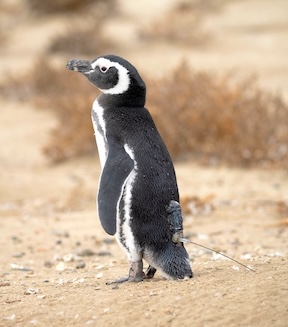
Magellanic Penguin (Spheniscus magellanicus) fitted with a satellite transmitter
(photo courtesy of the Global Penguin Society)
Join the MoveTraits Initiative
The MoveTraits Initiative is offering a new opportunity for Movebank users to contribute to global research and conservation policy. MoveTraits is an open-access behavioral trait database that makes the behavioral information contained in bio-logging data more readily accessible for comparative research and policy processes. MoveTraits calculates derived movement metrics directly from animal tracking data using standardised, consistent methodology and provides the information at three levels: species- and individual-level summaries as well as within-individual repeated trait measures.
In its current version, MoveTraits builds on open-access data stored on Movebank, featuring movement traits for 52 mammal and 97 bird species from over 6,000 individuals. However, we hope to significantly expand the number of included species and individuals in the future—with the help of Movebank data owners! We now invite owners of access-restricted studies to participate. You do not need to make your tracking data public, and you retain control over the resolution at which the traits derived from your tracking data are shared.
Watch this introductory video to learn how it works. You can contribute data and choose the scale at which you agree to share movement traits in a few simple steps. This interactive data-sharing tool guides you through the process—it takes about 10 minutes.
Those who join the initiative will be invited to become a co-author on the MoveTraits database and to be involved in an associated research project comparing intraspecific variability of movement traits across multiple taxonomic groups. The MoveTraits team is planning the next database update for autumn 2026. We hope that together, we can further increase the value of existing tracking data for research and conservation. If you have any questions, please reach out to movetraits@gmail.com.

Major infrastructure updates underway
Movebank has worked for almost two decades to meet needs for larger datasets, near-real-time information, and global initiatives integrating hundreds of studies. This newsletter highlights the ongoing success of these efforts. To prepare for future growth, we have begun rebuilding the infrastructure with a new set of technologies — a new database, APIs, and web portal — designed to scale for upcoming data management needs while improving performance. Our goals to support sharing, discovery, and archiving remain the same. All tracking data, studies, user accounts and sharing permissions will be migrated to the new system. As we approach the transition to these new services, we will share more information about what to expect. We thank you as always for joining us on this adventure to connect animal movement data and the people who care about them, through free services available to users around the world.
How to connect
Want to get involved or get started? Join us during our Monthly Movebank Meetups, held the second Wednesday of each month at 8:00 and 16:00 U.S. Eastern Time. These virtual sessions are an opportunity to ask questions and receive live support. You can also connect with us on Bluesky, X, and YouTube, or send us a message at support@movebank.org.

Sincerely,
The Movebank Team