 for animal tracking data
December 2025 Newsletter
Dear Movebank users,
As 2025 draws to a close, below are some highlights from this past year, and a preview of plans for the year ahead. Read on to take our user survey, learn about new software and training opportunities, and join new global efforts to harness animal movement data in support of biodiversity conservation.
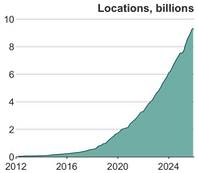
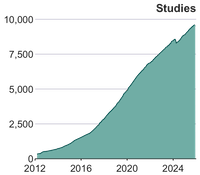
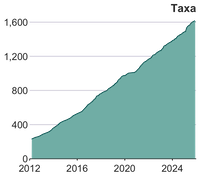
As of November 2025, Movebank hosts 9.3 billion animal locations stored in 9,600 studies managed by over 5,000 researchers, wildlife managers, and conservation groups. These represent the movements and behavior of close to 300,000 individuals and over 1,600 species. During 2026 we look forward to welcoming our 10 thousandth study and 10 billionth animal occurrence.
We are excited to announce that the Senckenberg Society for Nature Research has recently joined as a coordinating partner of Movebank, along with the Max Planck Institute of Animal Behavior, North Carolina Museum of Natural Sciences, and University of Konstanz. Senckenberg's expertise in biodiversity research, conservation policy, and natural history collections will help guide Movebank's development as a long-term digital biodiversity archive.
System renovation and user survey
During 2026, we will undertake a major renewal of the Movebank system to build scalability and sustainability. These upgrades aim to meet future needs for growing data volumes and transfer speed, software integration, and collaborative initiatives. What does Movebank mean for you? How could it better support your work? Please tell us by taking our user survey. We are accepting responses until February 1st.

Updates from MoveApps
Over the last year we have made many changes and improvements on MoveApps, our analysis platform for animal tracking data. On the website, this includes a new organization of the App Browser and layout of workflows on the Dashboard. Many apps have been upgraded based on user feedback—for example, try out upgrades to the Animated Map, Plot Tracks Colored by Attribute, Parturition, and Resource Selection Function apps. For monitoring ongoing studies, you can now receive alert emails as soon as a user-defined condition is met with the Email Alert App. You can explore some of these refurbished apps in the public workflows “New & improved: Create animations of tracking data” and “Email alert conditioned to distance moved”.
To learn more, visit the MoveApps news page.
Public data archiving
Currently, most animal tracking studies on Movebank and similar databases are not shared publicly, and are at risk of being lost to future generations. Public archiving ensures these natural history records remain available beyond the tenure of those who collected them. We are approaching the 400th data package published by the Movebank Data Repository. The repository has provided data review and formal archiving with DOIs for nearly 1,200 researchers, supporting data and code sharing for research published in 143 journals. This past year, we have added more Creative Commons licensing options and gained experience with publishing MoveApps workflows. Finally, we renewed our certification as a Trustworthy Data Repository through CoreTrustSeal.
Want to archive your data? Read here for details and to start a submission.
Wildlife movements in environmental context
For more than a decade, Movebank's EnvDATA System has offered an easy way to discover and link information from remote sensing and weather forecasting to animal tracking studies. In response to major changes in how these products are distributed, and the influx of new products becoming available, we are planning for new ways to offer these services. Over the next year, we will begin building new tools to support environmental data processing within MoveApps. A key part of these efforts is the continued development of ECODATA, a set of free software apps to process large geospatial data and create custom animations of wildlife movements. Together with our partners in the Yellowstone-to-Yukon region, we recently published a paper introducing ECODATA in Methods Ecology and Evolution. We also published animations for the two case studies described in the piece, illustrating road-wildlife interactions around Banff National Park and caribou calving in the Northwest Territories.
We are currently developing an ECODATA Annotation Engine App, supporting annotation of custom geospatial data layers to tracking and animal occurrence data—get in touch if you'd like to test the pre-release version.
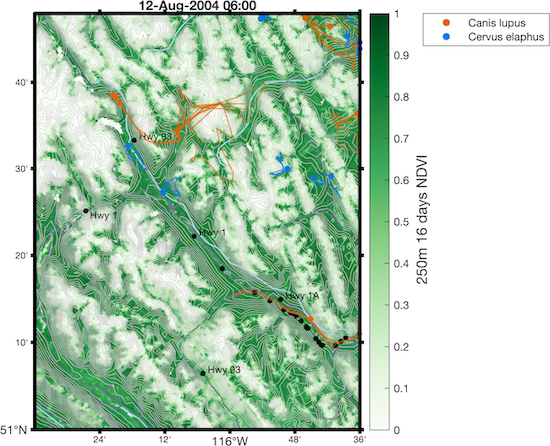
Image from an ECODATA animation of elk and wolf movements around highways
and over crossing structures in Banff National Park.
Connecting animal movements to biodiversity policy
Although movements of animals play a key role in ecosystem connectivity and health, and represent causes and consequences of changes in biodiversity, they remain underrecognized in national and multi-national conservation policy. This is in part because animal movement data—or usable information based on these data—are often not available to national policymakers. Movebank, along with other animal tracking data platforms, can contribute to solutions for this problem. We have helped to lead an effort, initiated by the Smithsonian Institution and WILDLABS, to establish a Biodiversity Observation Network for Animal Movement (Move BON). This network was endorsed by the GEO BON network in September, with the aim to close this science-to-policy gap. The group already has several active working groups planning the development of data pipelines and policy-relevant metrics, with the International Bio-logging Society's Data Standardization Working Group guiding development of data pipelines to support policy metrics.

Integrating animal behavior into trait-based ecology
Trait-based ecology offers an approach to understand and predict the composition of ecological communities and how they function, based on characteristics of individual organisms. To date, trait databases have not drawn on the wealth of available animal tracking data. We have recently demonstrated how animal tracking data can be integrated into trait-based data resources through Movebank. First, traits such as body size are commonly measured when tags are attached, and can be stored in Movebank along with tracking and other bio-logging data. A paper in the Journal of Experimental Biology compares publicly available trait measurements in Movebank and several trait databases, and identifies questions that could be answered by linking trait and tracking data.
Second, movement data themselves can serve as traits, if transformed into metrics that can be compared across species. The new MoveTraits Initiative has launched MoveTraits, an open-access behavioural trait database to make the behavioral information contained in movement and bio-logging data more readily accessible. It has begun with a set of common metrics, such as range size and displacement distances, for 52 mammal and 97 bird species, building on publicly available data on Movebank. We will soon begin expanding the database by inviting owners of access-restricted studies in Movebank to join, with options to withhold sensitive species locations. All contributing data owners can become co-authors on the database. Study owners, look out for an invitation early in 2026!
A paper introducing MoveTraits is in press at Ecology Letters—read it here!
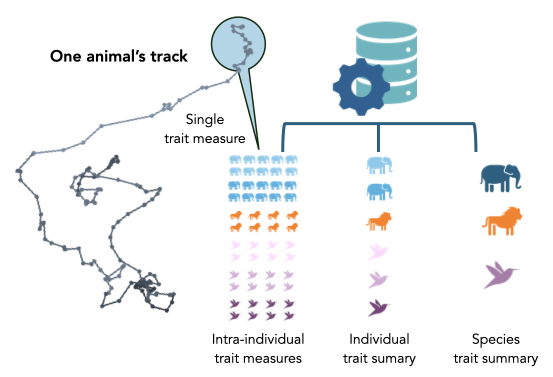
MoveTraits provides movement metrics summarised from individual animal tracks at three levels:
species, between individual and within individual.
Training, workshops and support
Over the past year, we've brought Movebank to the Gordon Research Conference (Ventura, USA), Living Data Conference (Bogota, Colombia), American Ornithological Society (St. Louis, USA), Move BON planning workshop (Washington, DC, USA), and Animove (Costa Rica).
In February, we will be presenting and running a workshop at the first International Conservation Technology Conference in Lima, Peru (registration is open). And in June, we will participate in the World Biodiversity Forum in Davos, Switzerland. Get in touch if you are planning on attending either of these events!
Want help using Movebank? Not sure where to start with a new project, or have questions about managing your data? Starting in January, our curation team will host a Monthly Movebank Meetup on the second Wednesday of the month.

Want to get involved or have feedback? Connect with us on Bluesky, X, and YouTube, or send us a message at support@movebank.org—and don't forget to take our survey. (If you don't want to receive these e-mails, please send an email to support@movebank.org with the subject "unsubscribe".)
We wish you happy holidays and a good start to 2026!
Sincerely,
The Movebank Team